Delaware Department of
Technology & Information


Delaware Department of Technology & Information


IT Business Cases


As authorized by Delaware Code Title 29 § 9004C(2), the Department of Technology and Information (DTI) establishes technology policies, standards, and guidelines for the State. Under this authority, an information technology (IT) initiative that meets specific criteria must begin with a business case submitted to DTI for approval before work begins.

A business case documents the rationale for a proposed IT initiative and gives DTI and the requesting agency a structured basis for planning and decision making. It supports the decision to buy, build, or integrate a solution; helps identify appropriate vendors or products; and informs the timing of implementation.

A business case should be submitted as soon as an IT project, or a component of an IT project, is identified. It should be submitted and approved before:

  • A grant or budgetary funding request is submitted.
  • An IT Request for Proposal (RFP) or Request for Information (RFI) is published.
  • An IT contract is signed.
  • A Proof of Concept (POC) is started.

When Is a Business Case Required?

When a business case is required

A business case is required for any new IT initiative, or any enhancement to an existing system, that meets one or more of the following:
  • The solution is cloud-based or uses artificial intelligence (AI) and contains State-owned data, regardless of cost or level of effort.
  • The estimated hardware and/or software cost is $100,000 or more.
  • The cost of professional services from a vendor or vendor partner to implement the solution is $100,000 or more.
  • The estimated scope of effort exceeds 500 hours of labor.

When Is a Business Case Not Required?

When a business case is not required

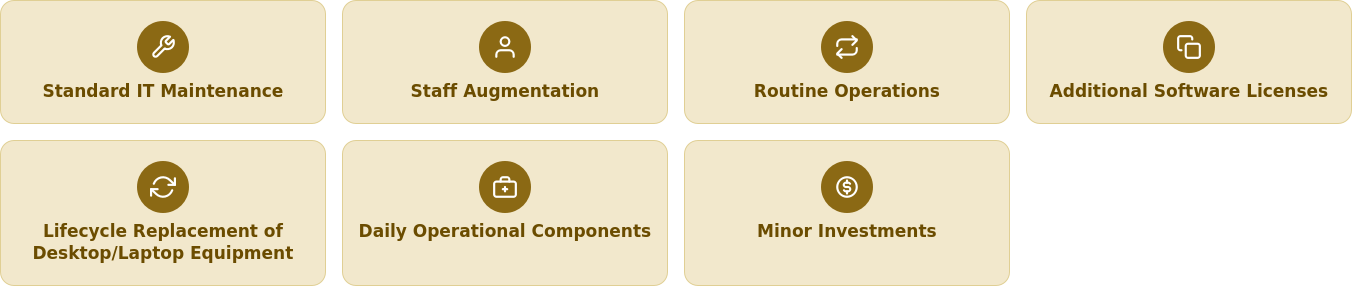
The categories below are exempt from the business case requirement.

  • Standard IT Maintenance. Renewals of existing hardware, software, and maintenance or support contracts are exempt.
  • Staff Augmentation. Procurement of IT contractor services for general staff augmentation that is not related to implementing a project is exempt.
  • Routine Operations. Maintenance and enhancements to an existing system are exempt from a business case, provided the effort does not:
    • Meet or exceed thresholds for estimated effort (500 hours), hardware/software costs ($100K), or professional services ($100K).
    • Expand the architectural footprint of the original system.
    • Violate architectural or infrastructure standards.
    • Alter the system’s documented data classification or mission criticality rating.
    • Compromise the system’s confidentiality, integrity, or availability.
    • Perpetuate the use of declining or non-standard architecture.

    Note: This exemption includes maintenance and enhancements covered by a Service Level Agreement (SLA) with DTI or by a software support contract with a third-party vendor, as well as maintenance or enhancement work requested directly from DTI.

  • Additional Software Licenses. Purchasing additional licenses for software already in production is exempt, provided the software is not identified as Declining, Discontinued, or Disallowed.
  • Lifecycle Replacement of Desktop or Laptop Computer Equipment. Replacing computer hardware is exempt, provided the hardware is not identified as Declining, Discontinued, or Disallowed.
  • Daily Operational Components. Purchasing operational supplies (for example, paper or ink), spare parts for daily operations (for example, memory or hard drives), on-demand equipment repairs, and IT training not tied to a business case project are exempt.
  • Minor Investments. Exempt when the out-of-pocket cost is under $2,500 and the total cost, including personnel, is under $100,000, provided the investment complies with technology standards.

Note: Two rules apply across all of the above exemptions:

  • Hardware or software must not be identified as Declining, Discontinued, or Disallowed on the applicable State of Delaware Enterprise Standard or Policy.
  • DTI reviews any IT-related purchase over $10,000. Notify your assigned Customer Engagement Specialist (CES) about upcoming purchases in this range.

If you have questions about whether an exemption applies to your situation, contact your assigned DTI Customer Engagement Specialist (CES).

How to Submit a Business Case

Information Resource Managers (IRMs) work with their business partners to determine who will submit business case requests for their agency. The IRM works with the agency’s assigned DTI Customer Engagement Specialist (CES) to set up access.

Once access is set up, submit the business case request through the ServiceNow IT Self-Service portal: Business Case Request Form.
Business Case Review Process

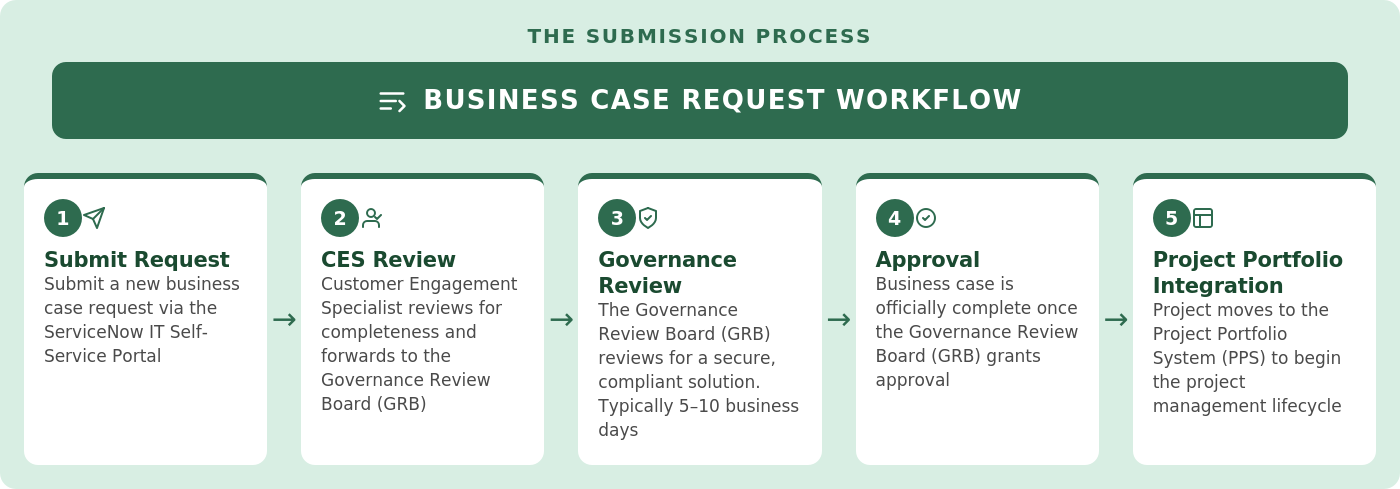
Business case request workflow
  • Submit Request. Submit a new Business Case Request via the ServiceNow IT Self-Service Portal.
  • CES Review. Customer Engagement Specialist reviews for completeness and forwards to the Governance Review Board (GRB).
  • Governance Review. The Governance Review Board (GRB) reviews for a secure, compliant solution. Typically 5–10 business days. DTI reviews each business case to:
    • Help customers find and implement solutions that meet their needs.
    • Confirm customers are not implementing a new technology when an approved enterprise solution already exist.
    • Confirm solutions comply with State standards and policies.
    • Confirm solutions are secure.
    • Identify projects that should be classified as Major Projects requiring further oversight.
    • Determine the level of DTI involvement needed in the project.
  • Approval. The Business case request is officially complete once the Governance Review Board (GRB) grants approval.
  • Project Portfolio Integration. Once the business case is approved, the project moves to the Project Portfolio System (PPS) to begin the project management lifecycle. The assigned project manager or project coordinator will manage the project from this point.

For more details, see the Business Case & Project Process Flow Overview.
Related Project Request Workflows

Related project request workflows

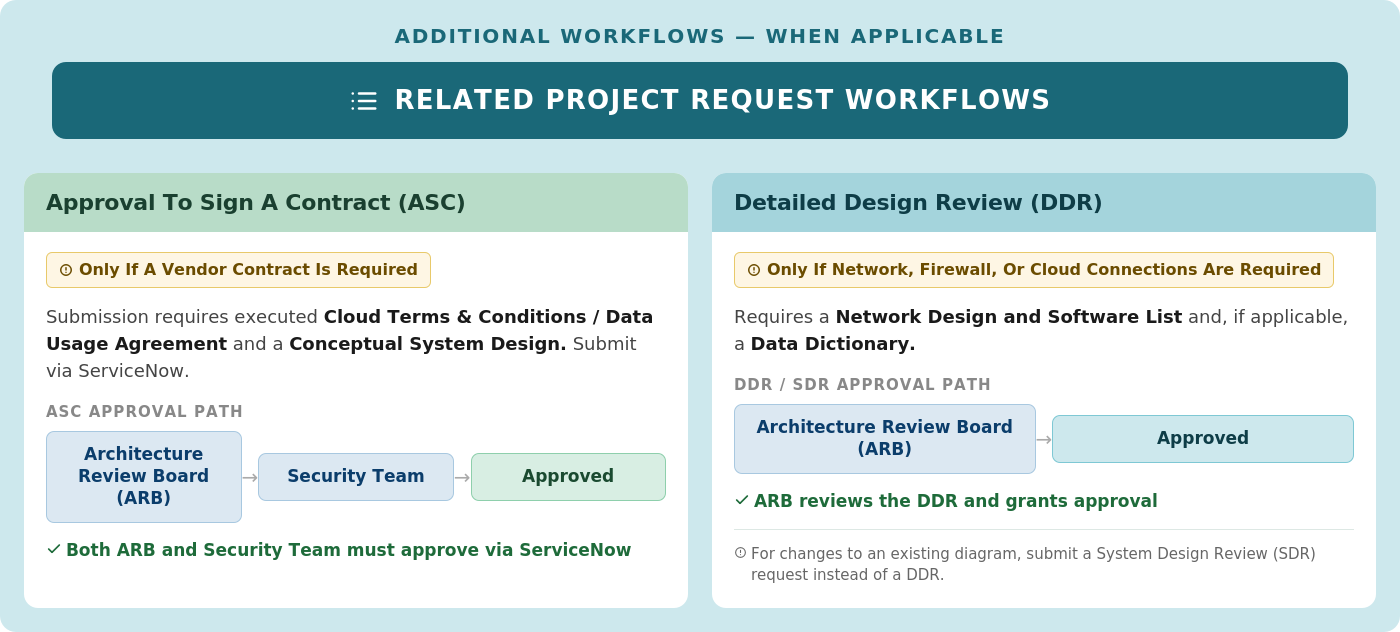
Depending on what the solution involves, a project may also need one or both of the following approvals in addition to the business case.

Approval to Sign a Contract (ASC). Required if a vendor contract is involved. Submit through ServiceNow with an executed Cloud Terms & Conditions/Data Usage Agreement and a Conceptual System Design. Both the Architecture Review Board (ARB) and the DTI Security Team must approve before the contract can be signed.

Detailed Design Review (DDR). Required if the project involves network, firewall, or cloud connections. Submit a Network Design and Software List, and a Data Dictionary if applicable. The Architecture Review Board (ARB) reviews and approves the DDR. If you are changing an existing design rather than creating a new one, submit a System Design Review (SDR) request instead of a DDR.

Information on the ARB process and ARB templates is available on the Architecture Review Board (ARB) site.

Questions?

Contact your assigned DTI Customer Engagement Specialist (CES) with any questions about whether a business case is needed or how to submit one.