Submit a Business Case
As authorized by Delaware Code Title 29 §9004C(2), the Department of Technology and Information (DTI) is responsible for establishing technology policies, standards, and guidelines for the State. In accordance with this authority, any information technology (IT) initiative must begin with the submission of a business case to DTI for approval before work begins. This requirement includes preliminary activities such as preparing and publishing a Request for Proposal (RFP).
The business case documents the rationale for the proposed initiative and provides a structured basis for planning and decision making. It supports evaluations of whether to buy, build, or integrate a solution, identifies appropriate vendors or products, and informs decisions regarding the timing of project implementation.
A Business Case is required for any new IT initiative or any enhancement to an existing system that meets any of the following guidelines:
- Estimated effort exceeds 100 hours
- Estimated hardware and/or software cost exceeds $10,000
- Requires an expense of $50,000 or more for Professional Services from a vendor, or vendor partner, to implement solution
- Cloud solution and contains State-owned data, regardless of cost or level of effort
- Server-based application residing on the State network that does not have a previously approved network diagram, regardless of cost or level of effort
- Proof of Concept (POC) for an application or system that will meet the above guidelines if implemented.
Note: A new Business Case is required upon completion of the POC if the decision is made to move forward with a production implementation.
IRMs are responsible for working with their business partners to determine who will have the ability to submit a Business Case request. The IRM will work through their CES to set up access. Once access is established, submit a Business Case or related IT Request.
Process Overview for Business Case and Related Requests
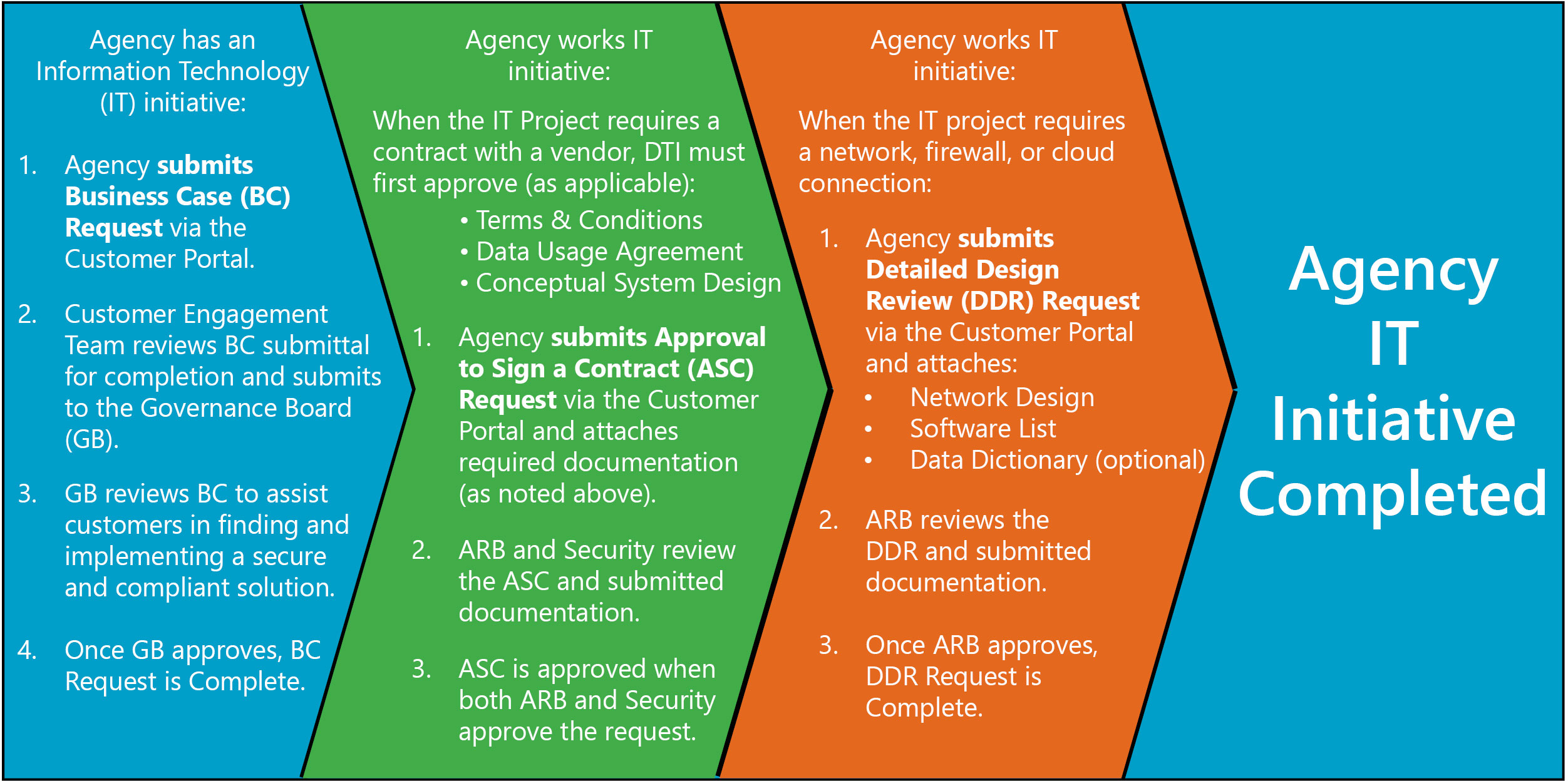
A High Level Process Flow Overview is available for if more detail is needed.
Information on ARB Process and ARB Templates can be found on the Architecture Review Board (ARB) site.
The business case is reviewed by DTI to:
- Assist customers in finding and implementing solutions to meet their needs
- Ensure customers are not implementing other technologies when an approved enterprise solution already exists
- Ensure solutions comply with state standards and policies
- Ensure solutions are secure
- Determine projects that should be considered Major Projects that will need further oversight
- Determine the level of DTI involvement in the project.
The Governance Review Board generally reviews and approves Business Cases within 5-10 business days. However, if the Governance Review Board has questions the review process may take longer.
Business cases should be submitted when an IT project, or component to an IT project, is identified. It should be submitted and approved before:
- Grant or budgetary funding requests are submitted
- An IT Request for Proposal (RFP) or Request for Information (RFI) is published
- An IT contract is signed
- Network and/or firewall rules changes/additions. These require review by the Architecture Review Board (ARB):
- Approved network diagrams are required before an IT system is implemented
- Servers cannot be built, and firewall rules cannot be created without an approved network diagram
- Cloud systems require an approved network diagram before implementation.
Business Case Examples
Examples of projects that need a business case are as follows:
- Implement a cloud IT solution
- Implement a custom-developed IT solution
- Implement a commercial-off-the-shelf (COTS) IT solution
- Automate manual processes with an IT solution
- Combine existing disparate processes with a single IT solution
- Re-architect an existing IT solution
- Replace an existing IT solution with a different solution
- Implement a document management solution
- Install a security system
- Integrate existing IT solutions
If you have any questions relating to the need for a business case or guidance regarding submission of a business case, contact your assigned Customer Engagement Specialist (CES).
Business Case Exemptions
There are exceptions to the requirement for a business case as follows. If you have any questions or want guidance in the interpretation of these exemptions, contact your assigned CES.
- Hardware / Software license / maintenance (support contract) renewals do not require a business case.
- DTI will review any information technology related purchase in excess of $10,000. IRM’s should notify their CES regarding upcoming purchases.
- Procurement of IT contractor services for general staff augmentation or to support a specific project (not for services from the solution vendor or vendor partner) do not require a business case.
- DTI shall be consulted regarding the use of contractual resources for information technology initiatives and support in excess of $50,000 prior to the work commencing. IRM’s should notify their CES regarding upcoming purchases.
- Maintenance and/or enhancements to existing systems that meet the following criteria do not require a business case.
- Do not fundamentally expand the architectural footprint of the original system, and
- Require no hardware or software purchase other than additional licenses, and
- Do not violate architectural or infrastructure standards, and
- Do not alter the documented data classification of the system, and
- Do not alter the mission criticality rating of the system, and
- Do not compromise the system’s confidentiality, integrity, or availability, and
- Do not unduly perpetuate use of declining or non-standard architecture.
This includes normal maintenance and enhancements covered by an SLA with DTI or by a software support contract in place with a 3rd party vendor, as well as those requested of DTI by submission of a maintenance or enhancement request. If, however, the estimated effort for enhancements exceeds 100 hours of DTI Labor, $10,000 of hardware/software, or $50,000 of Professional Service, it will require a business case.
- Additional software licenses do not require a business case.
- Software product must already be in production use; product must not be identified as Declining, Discontinued, or Disallowed on applicable State of Delaware Enterprise Standard or Policy.
- PC/desktop equipment replacements do not require a business case.
- DTI will review any information technology related purchase in excess of $10,000. IRMs should notify their CES regarding upcoming purchases.
- Daily operational components do not require a business case.
- Supplies to support IT operations (e.g. paper stock, preprinted forms, ink cartridges, tape cartridges, etc.)
- Spare parts for equipment supporting day-to-day operations (e.g. memory, hard drives, monitors, etc)
- On-demand repair services to operational equipment
- IT related training / education unless it is directly related to a project that requires a Business Case.
- Minor investments do not require a business case when:
- There is no use of non-standard technologies
- The total out-of-pocket cost is less than $2,500; the total cost (including personnel) is less than $10,000.